| TECHNOLOGIES | ||

|

In the design of a glider with a very large and slim structure – like eta – the results of flutter investigations must not be left to chance. Gliders are typically checked by a ground vibration test for flutter after building the prototype. In this test the glider is attached to a smooth spring and made to vibrate by electromechanical actuators. All natural oscillations of the glider are detected. These results are used in a special program for analysis of the unsteady aerodynamic forces by Professor Doctor Norbert Niedbal and checked for coupling which may lead to flutter during flight. With eta the analysis has got a range of the first bending frequency lower than 1 Hz up to higher complex eigenmodes at 70 Hz.
Due to this process the possibilities for correction of the natural motion forms of the glider are rarely given, so during the design process of eta a complete numerical analysis of all natural shapes of vibration including the wings steering mechanism was done. These numerical results replacing the data of the ground vibration test where used for the fluttercalculation. In an interactive procedure stiffness requirements where defined and used in the design of the structure.
So it is to be said, that about 80% of the design of this sailplane was given by elastical criteria, just about 20% where designed by static loads defined by the air worthiness requirements for gliders and motorgliders (JAR 22).
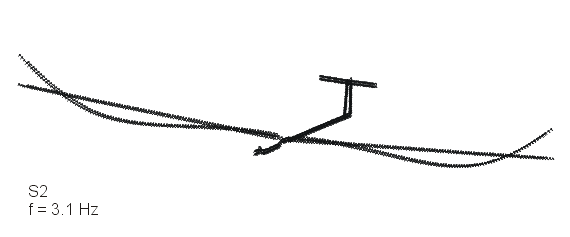
This picture shows the second natural oscillation in wingbending. The amplitude of the real glider is not as large as this picture, it is superelevated in this picture.
last changed: 15.11.1999 |