| TECHNOLOGIES | ||

|

A special problem for open class sailplanes with large wing span results from different flow velocities along the span during circular flight. Therefore there are consequences for the wings geometry and the design of the wing’s control mechanism. eta has got three sets of wing flaps. They facilitate efficient of the flap-setting for landing, with the inner flap set to about 55°, the middle flap on the maximum normal setting for circling, and the outer flap set to a significant upper position.
Due to the large wing span a large, effective fin is needed for good handling.
Differential Aileron Throw
The design of the control mechanism of the ailerons was done for good handling in steep circular flight. A high differential throw is a good way to reduce the negative yaw. In addition the design was optimized to obtain a very small rise of induced drag from deflection of the ailerons.
Flaperons
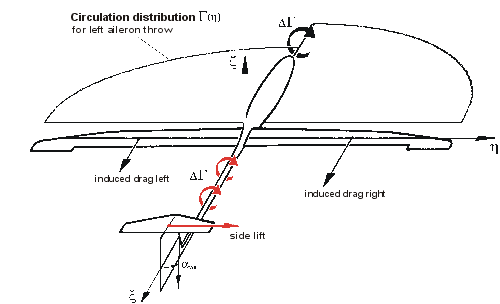
Flaperons are the wing’s flaps with mixed deflection for flap settings and aileron throw. eta has got all three flaps used as flaperons. The inner flaperon has just a lilttle throw by aileron which has got a sufficient skip in circulation distribution leading to a vortex going downstream to the fin (s. drawing). This vortex leads to a side wind on the fin with a lift as result. This leads to a yawing moment in opposition to the negative yawing-effect caused by aileron deflection, making possible a flight without sideslip.
This effect could be increased by larger aileron throw of the inner flap but there would be a rise in induced drag, so to optimize performance it was not used to excess.
Trimmable Fin
eta has got a long fuselage tail tube to enhance the authority of rudder. The elevator is involved with a special effect thereby:
In circular flight the sailplane´s center of gravity moves around the middle of the circle. Due to that the tailplane experiences an additional angle of attack from the outer side. With bank there is also an additional angle of attack for the elevator thus the elevator is already deflected negative while circling. To overcome this additional angle of attack there must be a reasonably higher throw of the elevator. In some cases – especially forward locations of center of gravity – the effectiveness of the elevator is not enough.
In any case the elevator will be out of the laminar bucket. This leads to loss of performance and lack of handling qualities because of the discontinuity of stick forces at the point of transition from laminar flow to turbulent flow and vice versa.
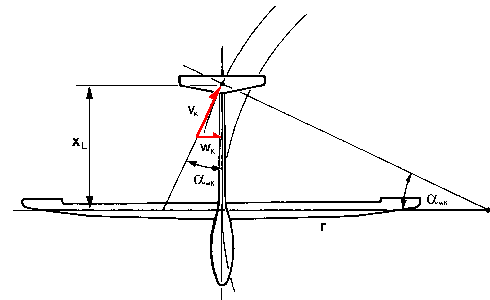
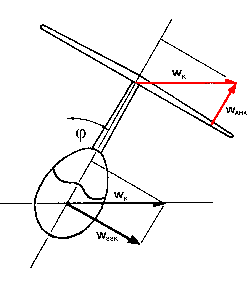
So for eta there is a trimmable fin used. By this measure the fin can be adjusted to the best position so that all stationary flight conditions can be flown with small throws of the elevator. Control of the trimmable fin will be led by the flap-setting so there are no additional controls for the pilot. For trimming there will be a usual trim by spring.
The optimal position for performance of the center of gravity for a sailplane with a high aspect ratio is in a middle range. With 15m gliders there is an advantage in having a little part of lift at the elevator due to the smaller relation of aspect ratio of wing and elevator, by setting the center of gravity to an aft position. On a sailplane like eta with high relation of aspect ratios it is not useful at all. The advantage of enhancing the authority of the elevator is not useful too, due to the advantages of the trimmable fin.
Carbon Fibre Rods
To prevent differential thermal elongation between the wings structure and the control mechanism in the wing, pushrods for flaps and aileron are made from carbon fibres. Without this, the differences in thermal expansion would lead to a shifting of the flaps with an unwanted twist of the wing with a rise in induced drag and loss of performance.
With the anisiotropical behaviour of the rods it was possible to differentiate the design stiffnesses forbending and stretching. The push rods being used do have a bending stiffness as an aluminium rod of 16x1mm. Stretching stiffness is about twice the value for this aluminium rod. Thereby the long control rods do have a stiffness we are accustomed to in 15m-gliders.
Brakes
Good flight characteristics and handling qualities are not only based upon control adjustment and nice circular flight. Effectiveness of spoilers for a steep and smooth, controllable approach is needed too.
Thus eta has large Schempp-Hirth brakes and effective flaps with the inner flap set to about 55°, middle to 22° and the outer flap to 16°.
| Mainsite | last changed: 15.11.1999 |